Physical Address
304 North Cardinal St.
Dorchester Center, MA 02124
Physical Address
304 North Cardinal St.
Dorchester Center, MA 02124

Because we can’t alter the laws of chemical physics, the lithium-ion battery powering your smartphone is locked into a finite lifespan. However, your daily habits heavily dictate just how quickly that capacity slips away. For instance, letting your handset repeatedly plummet all the way to a dead 0% is a critical error you will absolutely regret once your cell health nosedives.
But what about your nightly routine? Does leaving your phone plugged in overnight cripple its lifespan in a similar way, or should you counter this by opting for a rapid morning top-off? In short: no, and no. Let’s separate the persistent online myths from the actual engineering reality.
While allowing your phone to sit at a maximum 100% state of charge perpetually isn’t ideal, the classic internet narrative that an overnight plug-in will rapidly cook your hardware is completely outdated. This was certainly a legitimate headache during the early days of mobile tech, but modern operating systems have evolved.
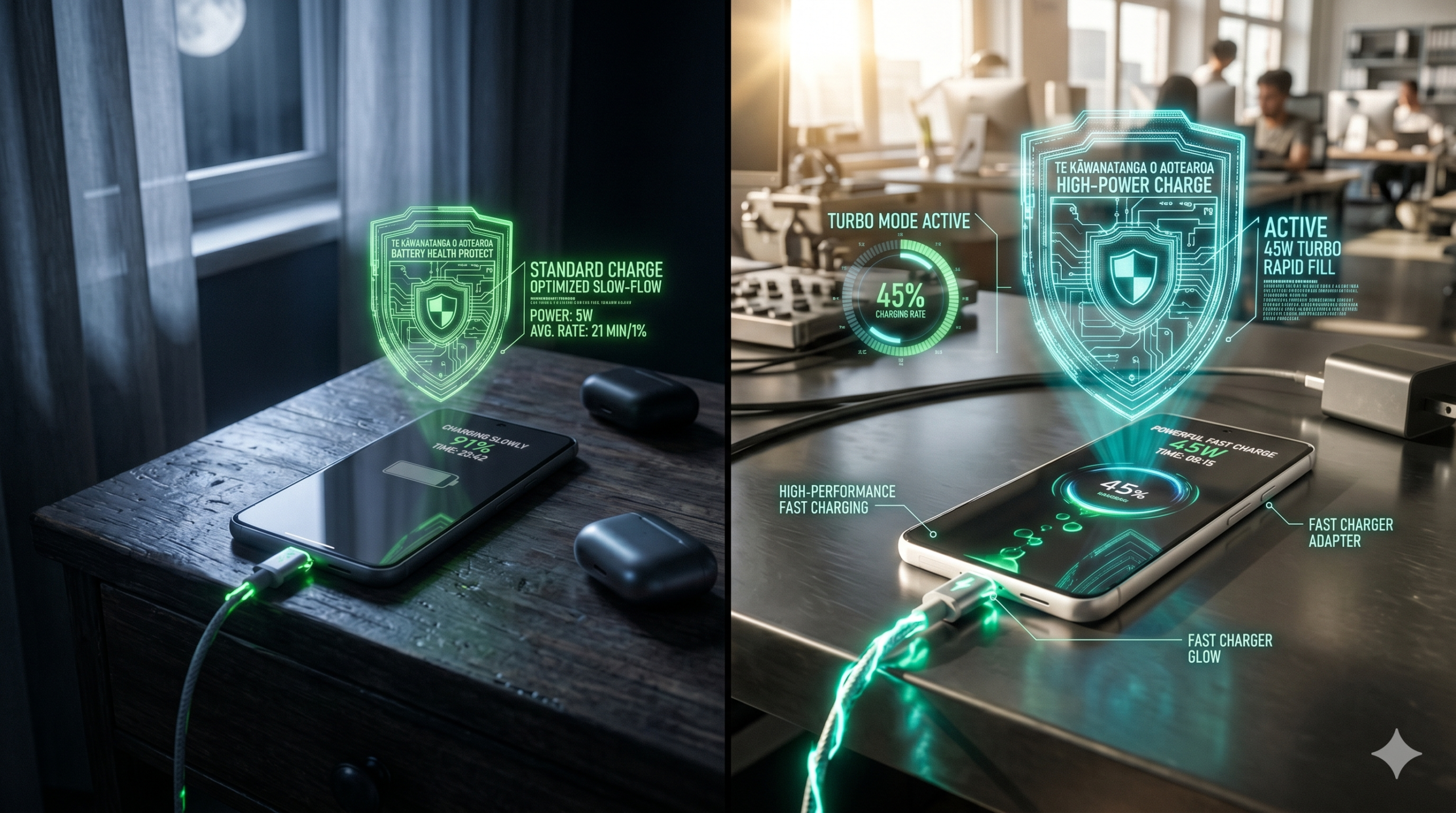
Both iOS and Android now ship with highly sophisticated, AI-driven battery management utilities. These features track your daily sleep schedule, deliberately freezing the power intake near the 80% mark for most of the night. The phone only quietly sips the final 20% right before your alarm rings, drastically reducing the total time your phone spends under high-voltage stress. In simple terms: overnight fueling is perfectly safe.
On the flip side, high-wattage fast charging is an incredibly convenient luxury when you’re in a pre-work rush, but it does degrade your internal hardware noticeably quicker than standard cycles. When it comes to the chemical engineering inside a phone, excessive **heat** is the absolute enemy of longevity.
A lithium-ion cell builds power as ions migrate back and forth between an internal anode and cathode. The higher the charger’s wattage, the more aggressively these ions are forced to move. While this cuts down your charging time, the friction creates an internal temperature spike that gradually breaks down internal electrolytes, trimming your overall maximum capacity over the months.
This doesn’t mean you need to discard your premium fast-charging blocks altogether. Instead, the ultimate evergreen strategy is a blended approach: use a slow, standard brick on a hard surface for your nightly bedside sleep cycles, and reserve the lightning-fast charging blocks exclusively for quick morning emergency top-offs before you walk out the door. Just remember to keep your device between that golden 20% to 80% sweep whenever possible, and let your phone’s built-in optimization settings do the heavy lifting.