Physical Address
304 North Cardinal St.
Dorchester Center, MA 02124
Physical Address
304 North Cardinal St.
Dorchester Center, MA 02124

The New Zealand Fuel Supply Chain Under Pressure
The global landscape is volatile, and nowhere is that volatility felt more directly than in New Zealand’s complex fuel supply chain.
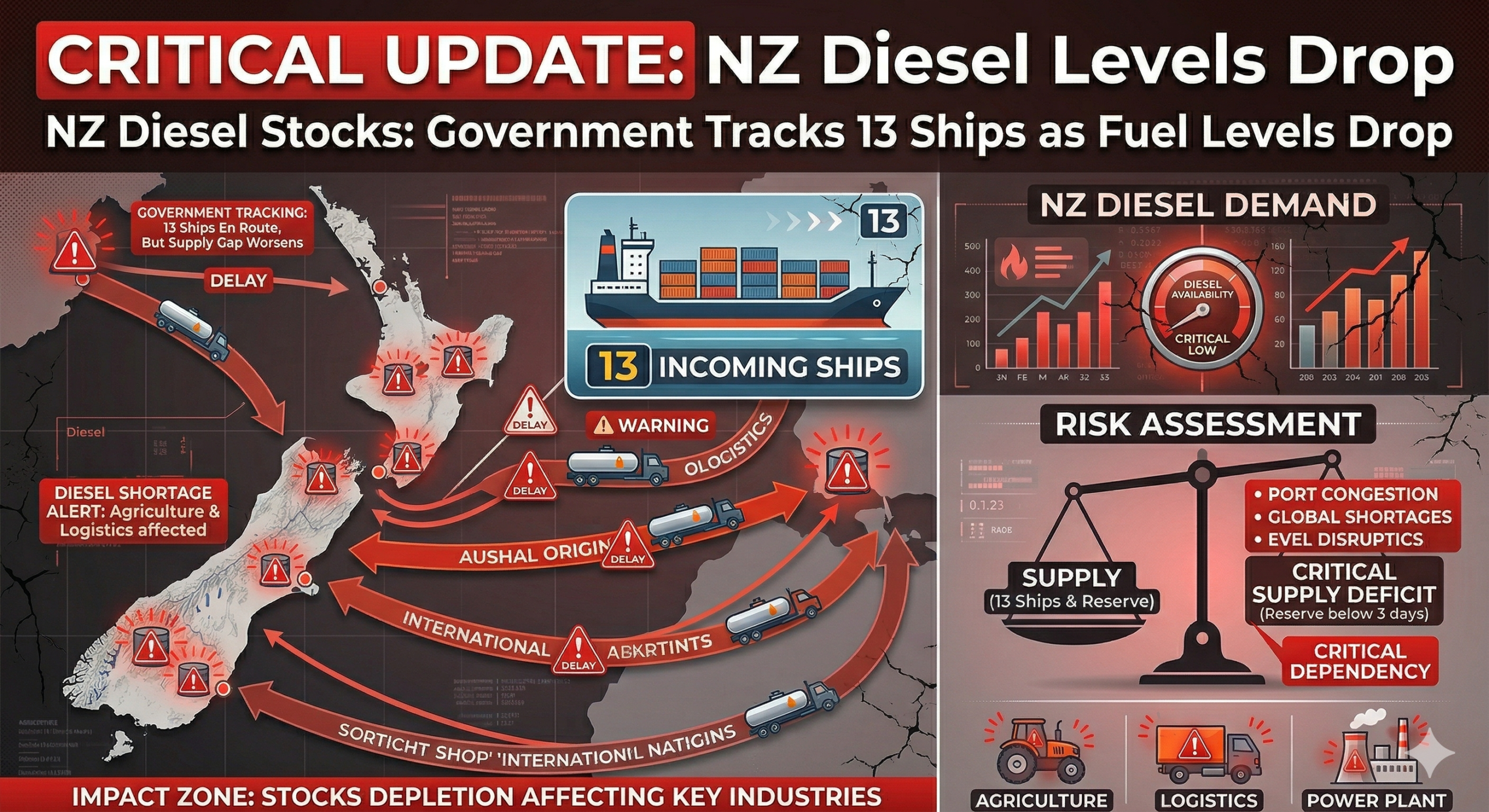
Elvion Pulse can confirm that Ministry of Business, Innovation and Employment (MBIE) officials have recently implemented a temporary tracking protocol for 13 critical fuel ships destined for NZ ports. The move comes as national diesel cover has dipped to approximately 18 days—well below the comfort zone of a modern economy.
While current commercial diesel stocks technically cover only about 24 days, the recent drop has introduced a degree of urgency not seen in the sector since the Marsden Point Refinery closure.
Why 18 Days is Critical
Fuel security isn’t just a political talking point; it is the lubricant of commerce. A “day of cover” refers to how long existing stock would last at average usage if supply was completely cut.
For industries that drive New Zealand—agriculture, long-haul trucking, construction—any prolonged disruption could be catastrophic. “18 days is uncomfortably tight,” says a market analyst specializing in the Asia-Pacific region. If one of those incoming tankers faces a significant delay in the Middle East or Singapore, we would see supply shortages.
The Domino Effect of Global Volatility
The current scarcity is intrinsically linked to rising tensions in West Asia (the Middle East conflict), which has affected shipping routes and global refinery outputs. New Zealand, being a remote “end-of-the-line” destination, is highly sensitive to these systemic shocks.
Looking for the ‘Pulse’ of Stability
While MBIE insists that a physical shortage is not imminent, the aggressive monitoring of the incoming fleet highlights a new reality for NZ energy strategy. The government has stressed that its “13 ships on the radar” protocol is a preemptive measure, ensuring data is available to intervene if necessary.
For businesses and commuters alike, the situation underscores the crucial interplay between international geopolitics and the price at the pump. Elvion Pulse will continue to monitor MBIE data as these critical shipments approach New Zealand waters.